Are the library's annual reports available online?
The library's annual reports are available within Annual Reports and Publications.
How can I obtain library collection statistics for grant applications?
For the purpose of completing grant applications, the library keeps a record of collection statistics.
Why does the library charge for printing services?
The library needs to recover costs for paper, toner, and maintenance of its printers. Charging for printing also reduces paper wastage.
How do I get a refund on my PaperCut account?
We will be happy to refund your PaperCut account for any bad copies made due to printer malfunction. Please bring the bad copies to the SmartDesk, and we will reimburse you by adding value to your account.
We regret that cash refunds cannot be given under any circumstance, even if you are leaving the institution, so please keep this in mind when putting money into your PaperCut account.
How do I add value to my PaperCut account?
Add cash value by using the Add Value Station in the Library Commons. The Add Value Station accepts $1, $5, $10, and $20 bills. They do not make change.
We regret that cash refunds cannot be given under any circumstance, even if you are leaving the institution, so please keep this in mind when putting money into your PaperCut account.
How do I create a PaperCut account?
You can create a PaperCut account through the WCM print management system at print.weill.cornell.edu. Click on the Register as a New User link in the bottom, right corner of the login box to create a new account.
What is the cost of printing and photocopying in the library?
The charges per exposure are:
WCM medical students, 1st and 2nd year PhD students, PA students and Computational Biology students are credited with a $20 PaperCut printing allotment each week. These funds are refreshed each Sunday evening and can be used for printing in the Library, Olin Hall, in the Ed Center, at the PRC or in the BRB. Students who have problems with their allotments should contact the Education Technologies Group (ETG) by navigating to myHelpdesk (http://myhelpdesk.weill.cornell.edu) or by sending an email to etg-support@med.cornell.edu.
Where are the printers/copiers and how do I use them?
There are two printers/copiers in the library - one in the Library Commons on the first floor, just past the SMARTDesk, and one in the 24/7 Study Room. A PaperCut account is required to print. Please visit Print and Photocopying for full details about printing and photocopying in the Samuel J. Wood Library.
How do I download free full text with EndNote?
EndNote can automate the task of locating full text files on the web by using bibliographic data stored in reference. Once found, EndNote downloads and attaches the PDF to the reference. EndNote uses several methodologies when searching for the full text of scholarly journal articles and conference proceedings. Depending on the subject area and recency of publication, this feature can work for more than half of one's citations.
To set up Find Full Text:
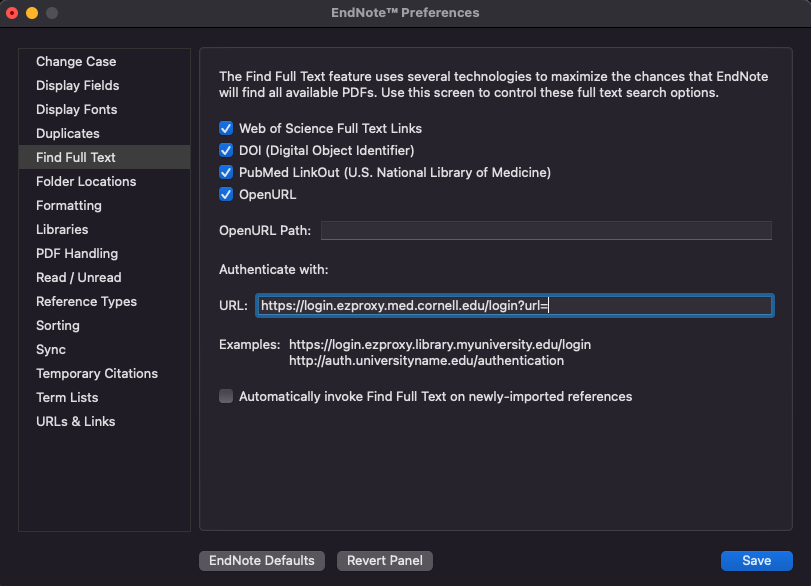
To use Find Full Text, either pull down the "References" menu and choose the "Find Full Text" command, or right-click on a reference and choose it.
To manually add a PDF attachment, go to the top menu of EndNote and select "References". Then select "File Attachments" and finally "Attach File". More recent versions of EndNote also allow manually adding full text by dragging a PDF file and dropping it on top of a record.
My screen-reading browser cannot read PDFs. How can I get PDFs converted to something useable like HTML or plain text?
Accessibility Tools for Adobe PDF documents provide several options for helping visually impaired users read PDF files using screen-reading applications. Please visit Adobe Accessibility for more information. The Adobe Acrobat Access View plug-in for Windows can be downloaded here. Mac OS users, or those using shared computers, can convert PDF files to text or HTML by using the email or web-based submission tools available at Online Conversion Tools for Adobe PDF Documents.

